Outside the Wire
2015 Afghanistan Documentary Film
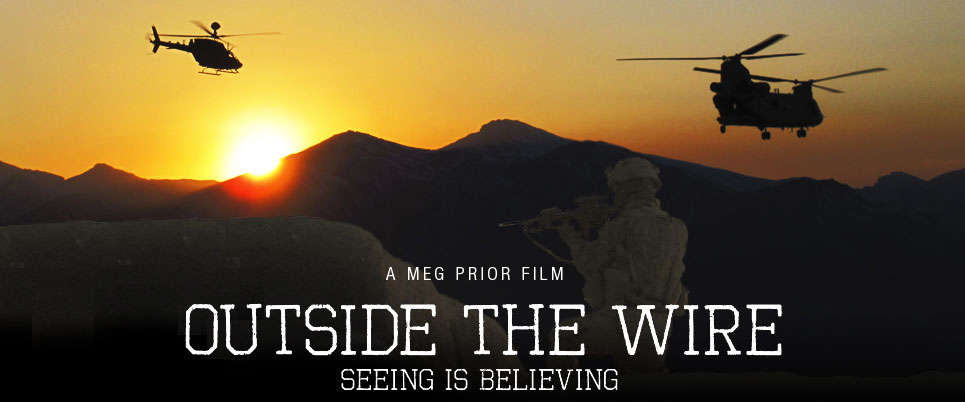
This was the official website for the 2015 Afghanistan documentary film, Outside the Wire, produced and directed by Meg Prior. Content is from the site's archived pages.
Go to the film's Facebook page to learn more about this extraordinary documentary and Meg Prior – Producer/Director/Writer
https://www.facebook.com/OutsidetheWiretheMovie/
Outside the Wire presents the most comprehensive contemporary visual capture of the changing character of war in the early 21st century.
Outside the Wire neither pursues nor neglects the hard realities, jarring paradoxes, and sometimes conflicting objectives of war. Footage shows both the kinetic edge of war-fighting and the realities of a complex counterinsurgency mission in support of a vulnerable country and populous ravaged by years of relentless conflict.
This collection illuminates the visceral realities of battle-zone and the day-to-day life of Soldiers and Afghans as they combat an unidentifiable enemy. It chronicles Afghans in their fight for survival and effort to regain control of their country, meeting with gradual, but tenuous, successes.
The exhibit invites one on an emotive trek: to uncomfortable places and unlikely moments that reveals what war looks like across the spectrum of engagement: high value targets, humanitarian, or combat missions. It shows what Soldiers actually do while deployed on missions and it depicts what is seldom shared with the public, yet is commonplace down range, thus increasing the fluency between civilians and the military.
Outside the Wire offers an unfiltered lens. It continues the dialogue about the role of the documentarian embedded in a contemporary war zone, and the historic footage-of-record captured.
The Filmmakers
MEG PRIOR: Producer & Director
Scholars and soldiers told me that war has an enduring nature, one that has not changed for centuries: that it is a contest of wills, is violent and uncertain; an extension of policy with a dominating political dimension. However, though the nature of war remains unchanged, the character of war constantly evolves. I desired to know what the latest evolutions of warfare looked like, and how this impacted our military. I wrestled with tough questions: how are our policy decisions playing out on the ground overseas? How is victory defined? What would be considered defeat?
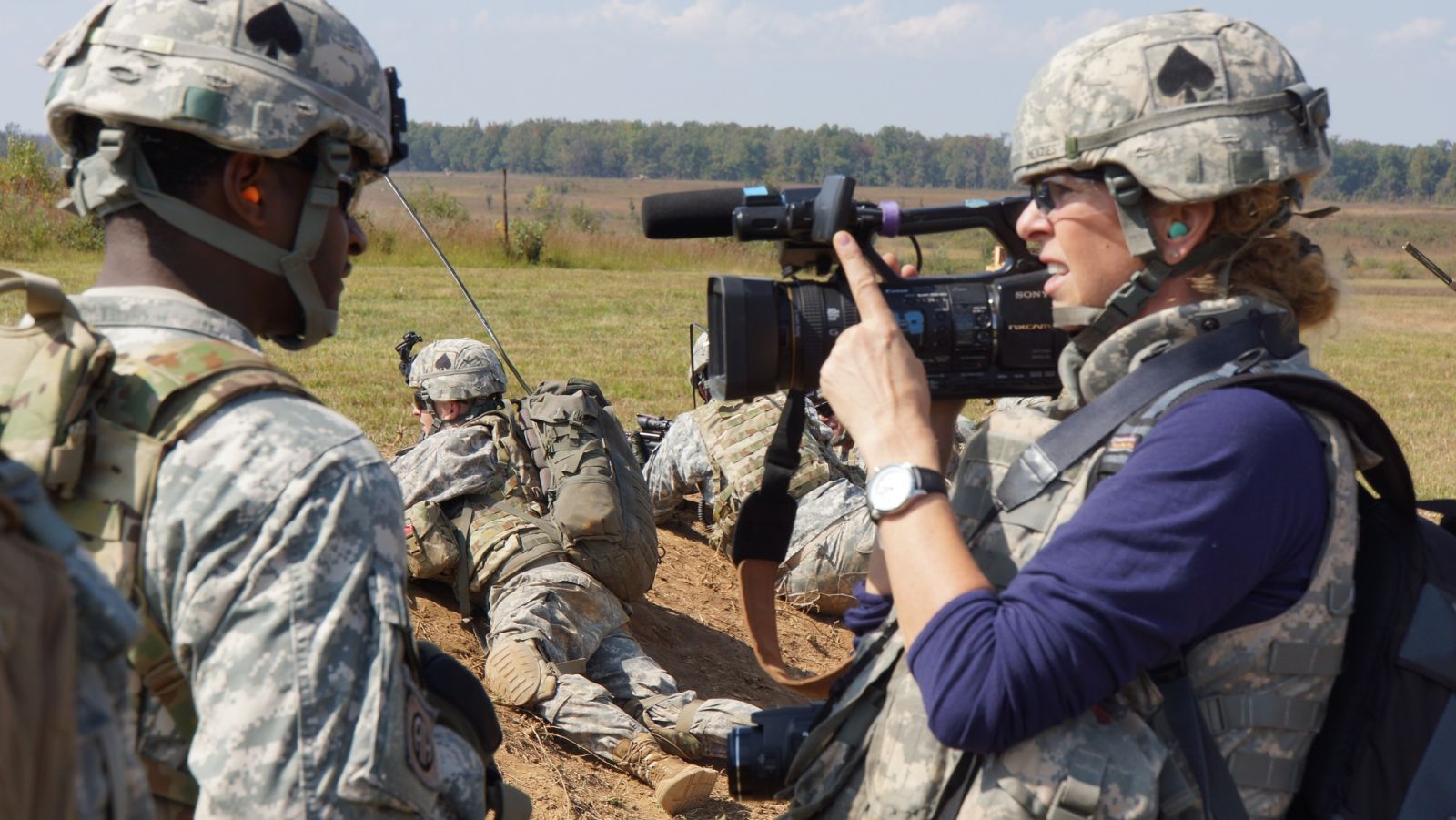
The rationing of information about today's conflicts bothered me greatly. Much of what my fellow citizens and I have been presented with are brief news reports devoid of context, war drama reality television shows of limited scope, or films recounting embattled troops in valley outposts—compelling and valorous aspects of the conflict, without question, but a more linear perspective of what are incredibly complex operations. What else was going on before and after these battles? I needed to know more.
The film becomes increasingly pertinent in the context of the current situation in Iraq (rise of ISIL; poor performance of Iraqi security forces) and a pressing U.S. timeline to reduce forces in Afghanistan. Is Afghanistan destined for a similar fate?
As a citizen, I wondered how policies such as "deny a safe haven for terrorists," "forge a lasting peace," and "manage conflicts that threaten our interests" are actually implemented, and experienced by all affected parties. What do young Americans do to turn these words into reality?
The Department of Defense approved a production assistance agreement authorizing me to embed with ground combat units and other services to produce a documentary film and photo exhibit about the military efforts in Afghanistan, from Fall of 2010 to the end of Operation Enduring Freedom in December 2014. Over the course of nearly five years, I have spent more than a year embedded with U.S. Army units in Afghanistan, documenting over 250 combat missions. The remarkable footage that resulted ranges from kill capture missions to mounted and dismounted patrols, air assaults and operations that result in kinetic contact, to humanitarian aid and civil affairs efforts. I have been there, done it, and have numerous t-shirts!
Though threats of terrorism against the United States long predate 9-11, U.S. national security policy has shifted its focus to countering terrorism in the post 9-11 world. Virtually all elements of national power have been leveraged to develop counter terrorism strategy, and drive its implementation. These policy decisions subsequently sent U.S. armed forces into harm's way in both Iraq and Afghanistan theaters.
I watched all this as a concerned citizen. I, like the majority of the American public, had little contact with the military. My preconceived notions of the realities of war were loosely drawn from academic sources, movies, and documentaries. My context was primarily derived from history and popular culture. But did these sources accurately portray the reality of these current conflicts?
Outside the Wire is less a stereotypical war film, and more a journey of understanding. Many questions were answered; important new ones were raised. Along this journey I met incredible people who volunteer to descend into violent, chaotic, and complex environments for me; for us. I completed the journey with a better awareness of them, of what we ask them to do, and the nature of the conflicts we find ourselves with increasing frequency ensnared.

TONY CUCOLO: Major General, U.S. Army (Retired)
Executive Producer & Military Technical Advisor
When I saw a rough cut of Meg Prior's work while I was at the War College 2012, I immediately knew it held great value and potential to educate and inform the public on the changed character of war in the 21st century and what it is like to be on the whip's end of national security policy. I believe this film does that, as well as give the public the most extensive, engaging, and in-depth view of the people who are currently serving our nation.
It has been an honor to be associated with this project.
I have served at the tactical, operational and strategic level during my 35 years as a Soldier. A combination of my experiences in operations in Bosnia, Afghanistan and Iraq, lessons from my four tours in the Pentagon, and service leading the U.S. Army War College made me both a student and a practitioner of the difficult task of linking policy and strategy to actions on the ground. Over the past decade I have had the opportunity to speak on this topic and attempt to explain the "why" of past and current operations to an extremely wide variety of audiences—from concerned citizens to the intellectual elite.
Each time I stood in front of a group and tried to describe just what it is young Americans do on the ground to make policy successful, I knew I fell short. I secretly wished the impossible wish of transporting the population of the United States to the battlegrounds of Iraq and Afghanistan so they could see their military and their diplomats in action, see the abject poverty, oppression, violence and destruction we sought to abate, and get a feel for the immense complexity of these environments.
And, thus far, 21st Century warfare is certainly proving to be incredibly complex. For the foreseeable future, war will continue to be waged among the world's populations. It is carried out by adaptable, cunning, and often well-resourced enemies who employ all means at their disposal, from crime and terror to the latest conventional weaponry and cyber operations. They ignore all rules of international order and they ignore all aspects of the law of armed conflict—in fact, they ignore humanity. Success against enemies such as these requires professional, ethical and truly enlightened warriors and diplomats—and constant communication of clear, adaptive policy goals for them to translate into actions on the ground.
I knew if my fellow countrymen could gain a better understanding of the grass roots realities of policy in execution, somehow see examples of it for themselves, I was certain they would take a greater interest in—and seek to be more informed—about the policy decisions sending Americans into harm's way.

SIOBHAN PRIOR: Editor
Siobhan Prior is a native Californian, born and raised in Los Angeles. She is a third generational vet in the film industry, following in her father’s and grandfather footsteps. Her grandfather, Peck Prior Sr., began his career as a commercial producer, and ultimately finished his career as the President of Technicolor. Under the steady tutelage of her father, acclaimed film editor Peck Prior, Siobhan quickly gained the knowledge, training and creative tools necessary in the art of editing and visual story.
Siobhan’s skill set is expansive, ranging from physical production, to managing dailies, to film-outs and digital outputs for theatrical release – her editorial sensibilities have been sculpted by the finest editors in Hollywood. Her career seamlessly spanned the 35mm to digital revolution, working in the VFX departments on films such as “Pleasantville”, “Disaster Movie”, and Sky Captain, World of Tomorrow”
After 10 years working on large scale feature films, Siobhan took her talents to Bandito Brothers – a full service independent media studio. In addition to editing commercials projects, she was given the opportunity to be an Additional Editor, VFX Supervisor and Co-Post Production Supervisor on the film “Act of Valor”. The movie was revolutionary in many ways, one of the most radical was that it was the first film that combined DSLR and 35mm film in a feature environment. The film opened #1 at the Box Office, and changed the way mainstream Hollywood approached feature film making, helping to solidify Siobhan’s standing as an innovator in the world of filmmaking and digital media.
Applying her background with “Act of Valor” (involving real Navy SEALs and accessed actual military assets), she joined her step-mother Meg Prior as an Editor and Post Producer on “Outside the Wire”, a documentary film about Meg’s civilian deployment to Afghanistan with the 101st Airborne Division of the U.S. Army.
JESSICA BRUCKERT: Project Manager
Jessica Bruckert studies Peace, War, and Defense and Anthropology at the University of North Carolina at Chapel Hill. She previously worked as a Department of Defense civilian with the U.S. Army Special Operations Command and Special Warfare Center and School at Fort Bragg, NC. There, she endeavored to improve the relationship between the military and knowledge capital communities in the private sector and academia. While accompanying the 98th Civil Affairs Battalion on a pre-deployment MRX at Ft. A.P. Hill in VA in 2011, she was delighted to learn vegetarian MRE's do in fact exist, then promptly burned herself attempting to "cook" one. Jessica traveled to Kabul, Afghanistan in the summer of 2012. While down range, she collaborated with NATO, U.N. and Embassy representatives to support U.S. efforts at combating transnational organized crime in Afghanistan. Engagements outside the wire included interfacing with senior Afghan Government Officials, Afghan Parliamentary members, and Afghan military and civilians at the Ministries of Interior and Defense. Jessica drafted communications for NATO/ISAF leadership and aided in the implementation of counter corruption measures. At Carolina, Jessica studies ways to improve operational efficiencies the military and reduce incongruities between strategic and tactical levels of warfighting. She is interested in supporting an open dialogue between civilians and veterans.
Jessica joined the OTW team to foster connections between Meg's material and external stakeholders. She leads development and outreach activities for the team.
Personal statement: What I find particularly compelling about Meg's material is that, unlike most contemporary journalists or film makers, her coverage spans the spectrum of operations: high value, kill and capture, humanitarian aid, governance, reconstruction, female engagement teams - in a way that can only be achieved over time and extensive travel in-country. 5% of war is kinetic - fire fights and blowing stuff up - but Meg's coverage also reveals the 95% that is incredibly constructive in helping to advance the infrastructure, education and reconstruction of a bruised society. These stories are compelling in their own singular way. Meg's work does not shy away from hard-hitting questions: Why do we go to war? How do we define success? Who is the enemy, and what is the visceral reality of engaging with him? Meg's work encourages viewers to validate or challenge existing positions about the Afghan war. She helps us to understand the topography of conflict absent an agenda about it, in an entirely apolitical way. Her work doesn't hesitate to entertain juxtapositions: the tedium and adrenaline of war, moments of vulnerability and bravery - often intertwined - through a raw and compelling visual narrative.
MEG PRIOR
MEG PRIOR is a seasoned conflict photographer, videographer and filmmaker.
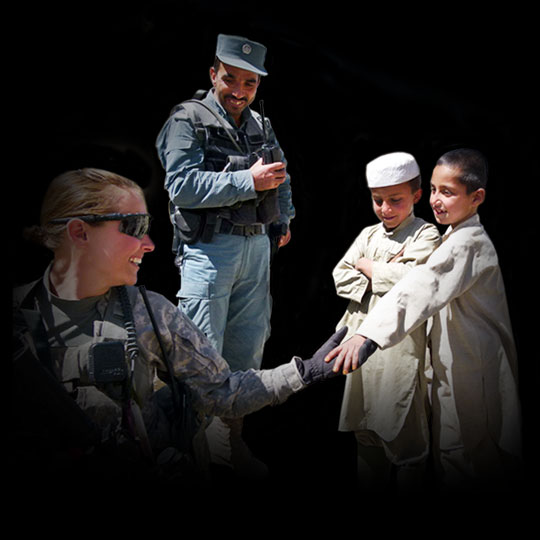
In her diverse and poignant catalog of work, we see Soldiers, unlikely emissaries, become the face of the diplomatic effort of this war; U.S. servicewomen on the front lines, engaging in firefights, a moment of raw emotional honesty exchanged between an American Soldier and an Afghan woman, and a spectrum of military combat operations.
Prior desired to gain perspective about the war in Afghanistan, the Afghan people, and what our nation's men and women experience in theatre as the implementers of a complex policy developed stateside. Prior bore witness to over 250 missions in some of the most contested areas of operation on our planet, capturing through her lens the nuances of contemporary warfare in a gripping and powerful testimony.
Over five deployments with the U.S. Army's 101st Airborne Division, the "Screaming Eagles", and multiple infantry divisions - 82nd Airborne, 10th Mountain, 3rd Infantry Division - in addition to other U.S. Army, U.S. Air Force, U.S. Marine, U.S. Navy, U.S. National Guard, U.S. Coast Guard, and U.S. Reserve units - she documented missions conducted during Operation Enduring Freedom in Afghanistan from 2010 to 2014, spending over a year sum in a forward deployed environment.
Prior utilizes a suite of multimedia instruments, including night vision photography and video.
More Background On& OutsideTheWireTheMovie.com
OutsideTheWireTheMovie.com was the official website associated with Outside the Wire, an American documentary project created by filmmaker and conflict photographer Meg Prior to examine the realities of modern warfare in Afghanistan. Associated with a 2015 documentary, the website introduced visitors to an unusually extensive collection of firsthand combat footage, photographs, personal experiences, and observations gathered during the American military campaign in Afghanistan.
Unlike conventional war documentaries that concentrate primarily on battles, military victories, or individual acts of heroism, Outside the Wire sought to explore the broader environment in which contemporary military operations take place. Its subject matter encompassed combat missions, humanitarian assistance, counterinsurgency operations, reconstruction, interactions with Afghan civilians, and the everyday responsibilities of American service members deployed thousands of miles from home.
The documentary developed from Prior's experiences embedded with American military units between 2010 and 2014. During that period, she spent more than a year in deployed environments, accompanied soldiers on hundreds of missions, and documented events that most American civilians would never have an opportunity to witness. Her work offered a perspective on the Afghanistan conflict that extended beyond the brief television reports and battlefield images commonly presented in mainstream news coverage.
The website served as a public introduction to the documentary, its creators, and its underlying educational mission. Although its historical significance is closely tied to the Afghanistan war, the project also raises enduring questions about military policy, the responsibilities of documentary filmmakers, civilian understanding of armed conflict, and the relationship between governments and the people who carry out their decisions.
History and Origins of Outside the Wire
The origins of Outside the Wire can be traced to Meg Prior's interest in understanding how American foreign policy decisions translated into military action on the ground. Following the terrorist attacks of September 11, 2001, the United States entered a prolonged period of military engagement in Afghanistan, initially focused on disrupting al-Qaeda and removing the Taliban government that had provided sanctuary to the organization.
Over time, the American mission expanded to include counterinsurgency, training Afghan security forces, supporting government institutions, and assisting with reconstruction. These activities created a complicated operational environment in which American service members were expected to fulfill military, diplomatic, and humanitarian responsibilities, sometimes during the same deployment.
Prior believed that the American public was receiving an incomplete picture of these operations. Traditional news reporting frequently emphasized major battles, casualties, troop deployments, and political developments, while the less dramatic but equally consequential activities of military personnel received comparatively limited attention.
Her documentary project emerged from a desire to understand what happened before and after the combat encounters that dominated public coverage. She wanted to observe how soldiers interacted with Afghan communities, how military commanders translated strategic objectives into operational decisions, and how ordinary people experienced a conflict that had continued for decades.
The U.S. Department of Defense approved a production assistance agreement that allowed Prior to embed with ground combat units and other military services. Beginning in 2010, she undertook multiple deployments and accumulated an extensive photographic and video record of military activities.
The documentary was associated with a 2015 production date, although the broader project continued through later public presentations and educational programs. The 2015 date should not be interpreted as evidence of a widely documented commercial theatrical release. Independent reporting from 2018 and 2022 shows that Prior continued presenting footage and discussing the documentary well after its initial production period.
Meg Prior: The Filmmaker Behind the Project
Meg Prior is an American documentary filmmaker, photographer, and videographer whose work focuses on military operations, conflict environments, and the experiences of people affected by war. Her professional background combines filmmaking, visual storytelling, and an unusually demanding history of athletic achievement.
Prior studied radio, television, and film at Western State College of Colorado before continuing her education at California State University, Northridge. She also pursued graduate studies in exercise physiology at California Polytechnic State University, San Luis Obispo. Her athletic accomplishments included competitive skiing and windsurfing, with published profiles describing national-level skiing success and a world speed record in windsurfing.
These experiences contributed to the physical endurance and adaptability required for documentary work in combat environments. Embedded filmmakers must carry equipment, travel with military personnel, adapt to changing security conditions, and maintain the ability to record events without interfering with military operations.
Prior's work in Afghanistan involved considerably more than filming from established military installations. She accompanied personnel on patrols, air assaults, combat operations, and missions involving Afghan communities. Her cameras recorded soldiers operating in difficult terrain, interacting with civilians, and responding to threats that could emerge with little warning.
She also used night-vision photography and video, allowing her to document operations conducted under conditions in which conventional filming equipment would have been less effective.
A particularly important aspect of Prior's approach was her position as a civilian observer. Although she worked closely with American military units, her stated purpose was to understand and document their experiences rather than simply produce promotional material. This distinction shaped the documentary's emphasis on observation, complexity, and the questions surrounding American military involvement overseas.
What the Documentary Covers
The central subject of Outside the Wire is the changing character of warfare in the early twenty-first century. Rather than treating war as a sequence of battles, the documentary examines the overlapping military, political, social, and humanitarian activities that characterized the Afghanistan campaign.
Its footage includes mounted and dismounted patrols, air assault operations, missions targeting insurgent leadership, engagements involving enemy fire, and the movement of American troops through contested territory. These sequences provide direct visual evidence of the physical demands, uncertainty, and dangers associated with combat deployments.
However, the documentary also devotes attention to activities that rarely receive equivalent public exposure. American military personnel are shown participating in humanitarian assistance, supporting local governance, working with Afghan security forces, and engaging with communities affected by prolonged instability.
The project's scope also includes the experiences of Afghan civilians. Their presence is important because military operations do not occur in isolation from the populations living in contested areas. Local communities must contend with security threats, economic hardship, political uncertainty, and the consequences of decisions made by both foreign military forces and Afghan authorities.
The film's underlying questions are therefore broader than whether individual missions succeed. It asks how military success should be defined, how strategic objectives affect people at the local level, and whether the intended results of military intervention correspond to the realities observed on the ground.
By presenting combat alongside governance, reconstruction, and humanitarian activity, Outside the Wire challenges the assumption that modern military campaigns can be understood solely through battlefield outcomes.
Military Units and Locations Featured in the Documentary
Although Outside the Wire was an American production, its principal filming location was Afghanistan. The documentary's geographic scope extended across military operating areas where American and coalition forces conducted missions during Operation Enduring Freedom.
Prior worked extensively with the U.S. Army's 101st Airborne Division, commonly known as the Screaming Eagles. The division has a long military history and is associated with Fort Campbell, Kentucky, an important installation for Army aviation and air assault operations. Prior also documented personnel from the 82nd Airborne Division, 10th Mountain Division, and 3rd Infantry Division, along with other military organizations.
Her coverage included members of the U.S. Air Force, Marine Corps, Navy, National Guard, Coast Guard, and Reserve components. This broad exposure allowed her to observe different operational responsibilities rather than limiting the documentary to a single infantry unit or deployment.
The documentary's locations were defined more by military operations than by tourist destinations or conventional geographic landmarks. Its footage followed personnel into Afghan villages, remote patrol areas, military installations, and regions where security conditions required close coordination between American forces and their Afghan counterparts.
The film was not associated with a public museum or permanent visitor attraction at a specific address. Its geographic identity instead reflects the locations where its material was produced and the American communities where the work was subsequently presented.
The Filmmaking Team and Production Leadership
Although Meg Prior was the central creative force behind Outside the Wire, the project benefited from a team with experience in military affairs, motion-picture production, editing, and public outreach.
Retired U.S. Army Major General Tony Cucolo served as executive producer and military technical advisor. His military career included service in Bosnia, Afghanistan, and Iraq, along with assignments at the Pentagon and leadership of the U.S. Army War College. His experience provided a valuable perspective on the relationship between national security policy, military strategy, and the activities of service members in operational environments.
Cucolo became interested in the project after viewing an early version of Prior's work in 2012. He recognized its potential to help audiences understand what American military personnel were being asked to accomplish and why conventional descriptions of military operations often failed to communicate their complexity.
Siobhan Prior served as editor and post-production contributor. Raised in Los Angeles, she came from a family with several generations of experience in filmmaking and technical production. Her grandfather, Peck Prior Sr., worked in commercial production and became president of Technicolor, while her father, film editor Peck Prior, contributed to her understanding of motion-picture editing and visual storytelling.
Her professional experience included work on major film productions and the military action film Act of Valor, which used real Navy SEAL personnel and military resources. That background was particularly relevant to Outside the Wire, where footage had to be organized into a coherent narrative without losing the authenticity of events captured in unpredictable environments.
Jessica Bruckert served as project manager, supporting outreach and connections with organizations interested in the documentary. Her background included work with U.S. Army special operations organizations and experience in Afghanistan involving NATO, diplomatic personnel, Afghan government representatives, and anticorruption efforts.
The combined expertise of these contributors helped position Outside the Wire as more than a collection of battlefield recordings. It became a multimedia project intended to communicate military experience to audiences who might otherwise have limited contact with the armed forces.
Documentary Style and Technical Production
One of the most distinctive features of Outside the Wire is its observational filmmaking approach. Prior's footage was produced in real military environments, where events could unfold rapidly and opportunities for recording could not always be anticipated.
The project is closely associated with cinéma vérité, a documentary tradition emphasizing direct observation and the recording of events as they occur. Rather than relying entirely on staged interviews, reenactments, or scripted narration, this approach allows viewers to experience situations through footage captured during actual activities.
At the 2018 Symposium on Modern Warfare, hosted through Texas Tech University's military history and research community, Prior's work was described as an example of how documentary films and photography can reveal the realities of the Afghanistan war. The presentation emphasized the educational value of recording events without rehearsal and allowing audiences to observe the military environment as witnesses.
Technical considerations were essential to this method. Combat filmmaking requires equipment that can withstand travel, dust, movement, changing light conditions, and prolonged periods of operation. A camera operator may need to move quickly from a wide view of a landscape to a close-up of a person's expression while remaining aware of surrounding activity.
In an interview published by Sony Professional, Prior discussed the importance of lightweight equipment, accessible controls, dependable zoom capabilities, and efficient digital workflows. She explained how the ability to move between distant subjects and close details could determine whether an important moment was captured or missed.
These production considerations helped distinguish her work from studio-based documentary filmmaking. The visual material was created under circumstances in which technical reliability and the filmmaker's ability to respond immediately were often more important than carefully arranged compositions.
Website Content, Navigation, and Visitor Experience
OutsideTheWireTheMovie.com functioned primarily as an informational and promotional website for the documentary and its creators. Its purpose was to introduce visitors to the project's subject matter, explain the filmmaker's motivations, and provide background on the people responsible for the production.
The available website content included a substantial overview of the documentary, statements from Meg Prior and other contributors, filmmaker biographies, and information about the military experiences represented in the footage. Visitors could learn why the project was undertaken, how its filming was conducted, and what distinguished its approach from more conventional war coverage.
The website also directed visitors to the project's Facebook presence, providing an additional way to follow the documentary and learn about related activities.
Its content was particularly notable for the length and detail of the filmmakers' statements. Rather than presenting only a short promotional description, the site explained the philosophical questions that motivated the documentary, including the changing nature of war, the relationship between military action and public policy, and the difficulties civilians face when trying to understand military service.
The website was not designed around retail transactions, restaurant menus, reservations, or physical visitor services. Its relevant content categories were documentary information, filmmaker profiles, production background, and project outreach. The publicly accessible material does not establish a comprehensive historical navigation menu, a ticket-purchasing system, or a permanent streaming library.
For visitors interested in the documentary, the website's principal value was its ability to place the footage in context. It explained the circumstances under which the material was collected and the questions viewers were encouraged to consider.
Public Screenings, Educational Presentations, and Audience Engagement
The documentary project found an audience through educational presentations, community programs, military-related events, and discussions about the Afghanistan war.
In April 2018, the Bear Valley Springs Cultural Arts Association presented Meg Prior as part of its Insights program in California. The event offered attendees an opportunity to hear about her experiences in Afghanistan and view photographs and video material associated with Afghanistan: Outside the Wire.
The presentation took place at the Bear Valley Springs Country Club near Tehachapi, California. Local reporting emphasized Prior's unusual access to military operations and her ability to explain aspects of the war that were not commonly visible to civilians.
A subsequent presentation was announced for May 14, 2022, at the Bear Valley Springs Oaktree Country Club. The event was described as a return appearance by popular demand, suggesting that her earlier presentation had generated sufficient local interest to warrant another program.
The 2018 Symposium on Modern Warfare provided another important setting for the project. Its agenda featured a presentation by Prior examining how documentary filmmaking and photography could encourage critical thinking about the Afghanistan conflict. The program discussed women in combat, the importance of observational filmmaking, and the use of documentary material in museums, broadcasting, education, and historical interpretation.
The project's educational activities continued into 2026. On July 16 of that year, Prior spoke at American Legion Hezzie Griffis Post 30 in Edgefield, South Carolina. Her presentation featured photographs and video from Afghanistan, including patrols through villages, helicopter operations, humanitarian projects, memorial ceremonies, and meetings between military leaders and Afghan officials.
A report published in August 2026 described how Prior's work had expanded over time. By then, she was reported to have accompanied American troops on more than 650 combat missions over approximately a decade, interviewing thousands of service members and accumulating extensive photographic and video archives. This later figure reflects her broader body of work and should not be confused with the more than 250 missions reported in the original website's account of the 2010–2014 production period.
These events demonstrate that Outside the Wire continued to have relevance long after its original filming. The documentary material became a resource for discussions about military history, veterans' experiences, and the long-term consequences of the Afghanistan war.
Press Coverage, Recognition, and Reviews
OutsideTheWireTheMovie.com and the associated documentary received attention primarily through military education, community reporting, and presentations rather than through a widely documented commercial film publicity campaign.
Coverage in The Loop, a newspaper serving the Tehachapi and Bear Valley Springs communities, described Prior's professional background and the educational purpose of her Afghanistan presentations. Articles published in 2018 and 2022 emphasized the depth of her experience, the unusual circumstances of her deployments, and the importance of sharing firsthand observations with civilian audiences.
The Texas Tech University symposium represented recognition within an academic and military-history setting. Its inclusion of Prior's work demonstrated that her documentary material was considered relevant to serious discussions about military operations, documentary ethics, and public understanding of war.
American Legion coverage in 2026 further established the project's appeal to veterans and military communities. The Edgefield presentation highlighted the emotional importance of preserving images of service members, including those who had died, and documenting experiences that might otherwise remain confined to personal memories.
The film is also listed in the Kinopoisk movie database under the title Afghanistan: Outside the Wire, with a 2015 production year and credits identifying Meg Prior as director and writer, Siobhan Prior as editor, and Penka Kouneva as composer. This listing provides an additional filmographic reference, although it does not establish the documentary's commercial reach.
A verified list of major film festival awards, theatrical box-office results, or extensive professional critic ratings was not found in the available sources. Similarly, there is insufficient independent evidence to assign the documentary a reliable aggregate audience rating or claim that it achieved widespread commercial distribution.
Its documented recognition is better understood through the continuing interest shown by military organizations, educational institutions, and communities seeking a deeper understanding of the Afghanistan conflict.
Popularity and the Documentary's Intended Audience
The audience for Outside the Wire differs from the audience typically associated with mainstream entertainment films. Its appeal is grounded in military history, documentary filmmaking, international relations, veterans' experiences, and the social consequences of armed conflict.
Veterans and active-duty military personnel represent an important audience because the documentary depicts activities and experiences familiar to those who served in Afghanistan. Its footage can preserve memories of deployments, military colleagues, operational challenges, and interactions with Afghan communities. For families of service members, the material provides a visual explanation of circumstances that may be difficult for veterans to describe in ordinary conversation.
The project also appeals to students, educators, military historians, journalists, and researchers examining American foreign policy after September 11. Its combination of combat footage and noncombat activities offers material for studying counterinsurgency, civil-military relations, military ethics, and the responsibilities of embedded documentary filmmakers.
Civilian viewers with little direct experience of military life were another primary audience. Prior repeatedly emphasized the gap between public understanding of military operations and the experiences of personnel carrying them out. Her work was intended to narrow that gap without requiring audiences to adopt a particular political position.
The documentary's exact commercial popularity is difficult to quantify. Publicly available information does not establish reliable website traffic figures, total streaming views, ticket sales, or comprehensive audience demographics. Nevertheless, the documented presentations between 2018 and 2026 indicate continuing interest in the material, particularly among military and educational audiences.
Cultural and Social Significance of Outside the Wire
One of the documentary's most important contributions is its examination of the relationship between American civilians and the military personnel who serve on their behalf. In the United States, military service is performed by a relatively small portion of the population, leaving many citizens with limited firsthand knowledge of deployment conditions or the practical consequences of national security decisions.
Outside the Wire addresses this separation by showing military personnel engaged in activities that extend far beyond combat. Soldiers appear not only as fighters but also as participants in diplomatic discussions, humanitarian efforts, security operations, and interactions with communities attempting to rebuild their lives.
This broader portrayal complicates familiar narratives about military service. A deployment may involve intense danger and long periods of routine activity, rapid operational decisions and prolonged negotiations, or destructive combat alongside efforts to improve local infrastructure. The documentary's importance lies partly in its willingness to present these contrasting experiences together.
The project also raises questions about how wars are remembered. Official histories frequently emphasize political decisions, military campaigns, and strategic outcomes, while the experiences of individual service members and civilians may receive less attention. Photographs and firsthand recordings help preserve details that can disappear from conventional historical accounts.
For Afghan civilians, the period documented by Prior was marked by extraordinary uncertainty. Communities faced violence, displacement, political instability, and economic hardship while foreign military forces and Afghan institutions attempted to establish security. The documentary's inclusion of Afghan experiences is therefore essential to understanding the human environment in which American operations occurred.
The withdrawal of American forces in August 2021 and the Taliban's return to power gave the earlier footage additional historical significance. Images recorded between 2010 and 2014 now document a particular stage of Afghanistan's political and military history, including the expectations, challenges, and unresolved questions surrounding international intervention.
The documentary can consequently be understood both as a record of military operations and as a resource for examining the limitations of military power, the difficulties of nation-building, and the experiences of people living through prolonged conflict.
Documentary Ethics and the Role of Embedded Filmmakers
Embedded documentary filmmaking presents ethical challenges that differ from those encountered in ordinary news or entertainment production. Filmmakers must balance the desire to record events accurately with security restrictions, the safety of military personnel, and the privacy and dignity of people affected by violence.
Access to military operations can provide extraordinary opportunities for observation, but it also creates questions about independence. A filmmaker traveling with military units necessarily experiences events from particular locations and perspectives. Even when the intention is to remain politically neutral, the selection of footage, editing decisions, and availability of subjects influence how viewers interpret the resulting material.
Outside the Wire is significant because its creators explicitly recognized the complexity of documenting modern warfare. Prior's approach emphasized observation and encouraged viewers to consider difficult questions rather than accepting simplified conclusions about the conflict.
Her extensive time in Afghanistan was an advantage in this respect. Repeated deployments allowed her to document activities beyond individual battles and observe relationships that developed over time. However, no documentary can capture every perspective on a war, and the material remains one substantial record within a much larger historical experience.
The project's value is therefore strongest when its footage is considered alongside Afghan testimony, independent journalism, military records, scholarly research, and other accounts of the conflict.
Other Films and Publications Called Outside the Wire
The title Outside the Wire has been used by several unrelated film and publishing projects, making it important to distinguish Meg Prior's documentary from other productions.
A particularly prominent example is the 2021 Netflix science fiction action film Outside the Wire, directed by Mikael Håfström and starring Anthony Mackie and Damson Idris. That film follows a drone pilot assigned to work with an advanced android military officer in a fictional conflict. Although it explores military technology and ethical questions surrounding warfare, it is not connected to Meg Prior's documentary or OutsideTheWireTheMovie.com.
Another separate production is Afghanistan: Outside the Wire, a 2010 documentary presented by Canadian journalist Scott Taylor and distributed through CPAC, Canada's Cable Public Affairs Channel. Taylor's film examines Afghanistan beyond the protection of NATO military bases, including the country's political conditions, reconstruction efforts, corruption, and the experiences of civilians.
The Canadian documentary was followed by Afghanistan: Outside the Wire – End Game, which received an advance screening in March 2014. These productions share subject matter with Prior's work but have different creators and production histories.
The title has also appeared in publishing. The University of Virginia Press released Outside the Wire: American Soldiers' Voices from Afghanistan, edited by Christine Dumaine Leche, in 2013. The book collects personal narratives written by American soldiers and explores the emotional and psychological experiences of military service.
These similarly titled works illustrate the broader cultural significance of the expression outside the wire. In military terminology, it refers to leaving the relative protection of a secured installation and entering an operational environment where threats and uncertainties may be greater. As a documentary title, it also suggests moving beyond familiar assumptions to encounter experiences that are usually inaccessible to the public.
The Website's Historical Value and Continuing Legacy
OutsideTheWireTheMovie.com remains important as a record of a documentary project that sought to make the Afghanistan war more understandable to American audiences. Its original content preserved the filmmakers' intentions, described the unusual circumstances of production, and introduced the people responsible for organizing an extensive collection of firsthand military footage.
The project's legacy extends beyond the website itself. Public presentations continued for years after the original documentary period, and by 2026 Prior's photographic and video archives were still being used to educate audiences about the experiences of American military personnel in Afghanistan.
The passage of time has changed the historical context in which the material is viewed. When filming began in 2010, American and coalition forces were still deeply engaged in counterinsurgency operations, and considerable attention was focused on strengthening Afghan institutions. By the end of Operation Enduring Freedom in December 2014, the mission had entered another phase. Following the withdrawal of American troops in 2021, the documentary's images acquired new meaning as records of an international intervention whose outcomes remain subjects of debate.
For historians and researchers, the footage offers opportunities to study military practices, interactions between soldiers and civilians, and the conditions that shaped daily life in Afghanistan during the conflict. For veterans and their families, it provides a visual record of service, sacrifice, and personal experience. For civilian audiences, it offers a way to examine the human consequences of decisions made by political and military leaders.
The available evidence does not establish the website's present ownership arrangements, a current commercial distribution agreement, or a comprehensive list of locations where the complete documentary can be viewed. Its continuing historical importance is nevertheless supported by the documented educational programs and public presentations associated with Meg Prior's work.
Ultimately, Outside the Wire represents an effort to preserve experiences that might otherwise be reduced to statistics, military reports, or brief news coverage. By documenting combat operations alongside humanitarian activities, military relationships, and the lives of Afghan civilians, the project encourages a more informed understanding of what war involves and how its consequences extend far beyond the battlefield.